
The Road to Digital Literacy
Addressing the digital divide
The Road to Digital Literacy
AT&T Blog Team
February 13, 2023
AT&T Blog Team
February 13, 2023
Key insights
01
Even in today’s “Golden Age of Connectivity”, some still lack the tools and resources to navigate the web safely and responsibly. But we’re working to change that.
02
As part of $6 million in contributions, we’re committed to bringing bilingual, in-person digital literacy workshops to more than 400 libraries and community centers across the country.
03
From East Coast to West Coast, we’re working with collaborators including Public Library Association, Connected Nation and Digitunity, as well as AT&T employee volunteers, to help newly connected parents, caregivers and families build confidence and skills using technology in our digital-first world.
Trying something new can be scary. Whether it’s small, like trying a new recipe; or big, like going back to school or embarking on a cross-country road trip. It takes an immense amount of courage to step outside your comfort zone to try new things. But it also takes an immense amount of support – as they say, “it takes a village.” We know not everyone has the access to the resources – or village – it takes to try new things. But we believe no one should be left behind on their journey, especially when it comes to the skills and resources needed to get online. Because sending an email or helping your child with online homework shouldn’t have to be scary.
It’s certainly easy to take for granted the ability to quickly search for the nearest gas station or schedule a doctor’s appointment online. But we know that over 30% of the U.S. population doesn’t have fixed broadband service, even though it’s available where they live. But why is that? Simply put, even in today’s “Golden Age of Connectivity”, some still lack the tools and resources to navigate the web safely and responsibly. But we’re working to change that.
Our commitment to help bridge the digital divide goes deeper than merely providing the access to fast and reliable internet. We’re working to help provide the resources and support necessary to take the leap to learn about computers and how to safely and effectively use the internet for everyday life.
In fact, last year, as part of $6 million in contributions, we committed to bringing bilingual, in-person digital literacy workshops to more than 400 libraries and community centers across the country.
We’re also teaming up with the Public Library Association to offer free online digital literacy courses, available through AT&T ScreenReady® and PLA Digital Learn. The nearly 20 free courses cover topics, including:
- Navigating a Website
- Basic Search
- Intro to Email
- Basics of Video Conferencing, and
- Using a Mobile Device
Let’s take a road trip across the country to see just a few ways we’re empowering Americans of all ages and backgrounds to get online by removing barriers to access, adoption and affordability of broadband internet.
New Jersey
AT&T is collaborating with Ironbound Community Corporation (ICC) in Newark, NJ and the Local Initiatives Support Corporation (LISC) on an initiative that assists people in the East Ward section of Newark with digital skills building and access. Support from LISC and AT&T is helping ICC bring the community up to speed with technology focused on online financial services, state and federal benefits, job training and development, and digital warning signs and safeguarding.
We also worked with the African American Chamber of Commerce of New Jersey, NJ STEM and the Athletic Arts Academy in Orange to run the NJ Kids4Coding program. The eight-week program introduced school-aged children to the basics of coding and how it can empower their imaginations, enhance their education, and catalyze career opportunities.
Raleigh
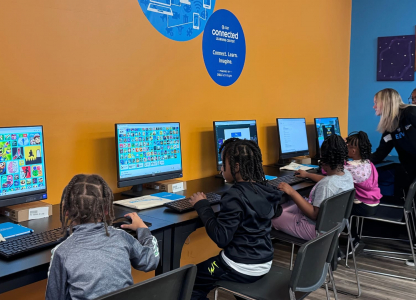
In Wake County, it’s estimated that more than 20,000 K-12 students don’t have access to the internet, computers or skills needed to benefit from the online world – and at least 1.1 million households in North Carolina remain unconnected. We recently opened a new Connected Learning Center (CLC) at the Boys & Girls Club Teen Center in Raleigh, not only providing a place where students and community members have free access to computers, wi-fi and high-speed internet, but also to free digital learning resources like digital literacy workshops and The Achievery, a free AT&T digital learning platform.
Michigan
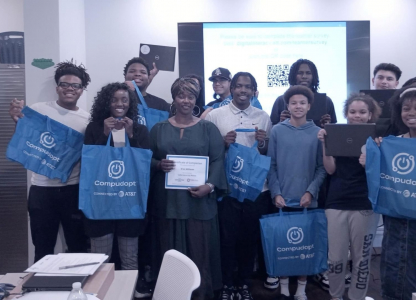
AT&T helped newly connected parents, caregivers and families gain the skills and confidence they need to use technology with free digital literacy workshops in Detroit, Hastings, Jackson, Adrian, and Kalamazoo this month.
Joshua Elling, CEO of Jefferson East, Inc. in Detroit hosted one of the workshops in his organization’s new AT&T Connected Learning Center. He said: “Tackling an issue as broad as digital literacy is not easy, but we strongly believe that on-the-ground, individualized support is the best way to make a difference for our most vulnerable local families.”
Los Angeles
During Hispanic Heritage Month, HACEMOS, AT&T’s Latino Employee Group (EG) dedicated to supporting Hispanic employees and the communities they live in, hosted a digital literacy workshop in Los Angeles at our CLC at the Salvadoran American Leadership Education Fund (SALEF).
HACEMOS volunteers provided training on basic internet activities, including how to use a web browser and search engine and how to navigate a website, as well as information on how to recognize a secure website and making passwords strong and memorable.
Pacific Northwest
Across Oregon and Washington, our teams are working in their communities to help connect even more of their neighbors. Addressing the digital divide and increasing digital literacy requires an array of specialized approaches to meet the specific needs of each community.
- In Portland, we contributed to the Black Parent Initiative in support of their K-8 programs. These year-round programs provide Black students with tutoring, access to technology and digital literacy skills.
- We contributed to the Girl Scouts of Western Washington, supporting a program that addresses the digital divide through a collaboration with DigiPen Institute of Technology by providing technology, women role models and mentoring so Girl Scouts can gain hands-on interface training using media technology and internet tools that aren’t available at home or in school.
From East Coast to West Coast, our teams are hard at work providing access and resources and building confidence in their communities to succeed in our digital-first world.
Learn more about the digital divide and how we’re providing digital literacy resources nationwide in the NowThis feature above.
Related stories
Addressing the digital divide
Expanding Digital Access in Las Vegas Through Device Distribution and Digital Literacy Training

