
Keep Kansas Competitive
Modernizing network infrastructure
Keep Kansas Competitive
Darin MillerVice President/State Director, AT&T Kansas
December 18, 2025

Key insights
01
Since 2000, consumers have chosen newer, more capable products for their communications needs, and as of the end of September 2025, we have seen a 98.6 percent decline in the number of AT&T traditional, residential landline subscribers since 2000.
02
Despite the significant work done to improve the investment environment and support initiatives that align with the needs of today’s consumers, we still face one key challenge: ongoing regulatory obligations require us to divert critical investment dollars toward maintaining and operating an outdated, legacy landline network providing a service most consumers have largely abandoned.
03
As a result of delays over the past 10 years, new legislation will be introduced to eliminate this regulatory stagnation. We will work with the state legislature to establish a pathway that allows AT&T to better meet consumer demands and transition away from outdated, decades old rules. Doing so would support investment and innovation that would help Kansas stay connected to opportunities for decades to come.
AT&T has delivered communications capabilities in Kansas for 146 years. And today, no one is doing more than AT&T to keep residents and businesses across the state connected.
In recent years, smart policy decisions have helped spur investment in broadband networks. In turn, these modern networks provide Kansans with more choices than ever before and help fuel economic growth in communities across our state.
In the past 25 years, we have seen more rapid change in the communications industry than at any other time. Around the year 2000, our legacy landline – or Plain Old Telephone Service (POTS) – subscribers peaked.
Since then, consumers have chosen newer, more capable products for their communications needs, and as of the end of September 2025, we have seen a 98.6 percent decline in the number of AT&T traditional, residential landline subscribers since 2000.

A changing communications landscape
The marketplace has grown, and consumers want to be able to do more than make a simple phone call. They want modern, high-speed products that can deliver greater data capabilities and reliability. AT&T’s investments are helping meet those needs.
Despite the significant work done to improve the investment environment and support initiatives that align with the needs of today’s consumers, we still face one key challenge: ongoing regulatory obligations require us to divert critical investment dollars toward maintaining and operating an outdated, legacy landline network providing a service most consumers have largely abandoned.
Eliminating regulatory hurdles
Since 2016, we have been in an active dialogue with the Kansas Corporation Commission (KCC), and through a series of petitions, we have sought to relinquish our eligible telecommunications carrier (ETC) designation so that we are better positioned to meet the needs of today’s consumers.
ETC was created four decades ago when basic voice services were the primary ways that consumers were connected, and competition was limited. Broadband was in its very early iterations, and consumer broadband was still a few years away.
The designation made providers, including AT&T, eligible to receive federal funds to provide voice service in hard-to-reach areas and offer discounted voice service to lower-income Kansans – with the goal of ensuring universal communications service across the country. Thanks to the evolution of technology and a fast-changing, competitive marketplace, AT&T no longer needs this designation.
- AT&T is the state’s largest provider of fiber-optic connectivity, with service available to more than 370,000 customer locations in Kansas as of the end of 2024
- Kansas is 5th among U.S. states in Fiber-to-the-home availability as of 2024. [1]
- Wireless and satellite broadband solutions have also entered the fray.
Today, there are 38 entities providing voice services in Kansas. Among those, 16 are designated as ETCs. And across all areas that were part of our most recent filing with the KCC, there are at least four other ETCs providing voice services – and as many 13 other providers offering voice services with a lifeline discount to customers in those areas. Federal law requires a minimum of one other provider, and the robust competition in Kansas well exceeds that threshold.
Across 19 of our 21 footprint states – including Kansas – we have petitioned to relinquish our ETC designation statewide. 18 of those 19 states have granted AT&T’s request to fully relinquish its ETC designation. Kansas has not.

What’s next
ETC rules were designed to serve the interests of the communications marketplace in the 1990s. That communications marketplace has evolved beyond the point of recognition, and Kansas’ ETC framework does more to complicate investing in broadband in Kansas than it does to further the public interest. To keep Kansas on the cutting-edge, its regulations need to be updated.
As a result of delays over the past 10 years, new legislation will be introduced to eliminate this regulatory stagnation. We will work with the state legislature to establish a pathway that allows AT&T to better meet consumer demands and transition away from outdated, decades old rules. Doing so would support investment and innovation that would help Kansas stay connected to opportunities for decades to come.
[1] Fiber Broadband Association | The Progress of U.S. FTTH Availability by State (May 5, 2025)
Related stories
Modernizing network infrastructure
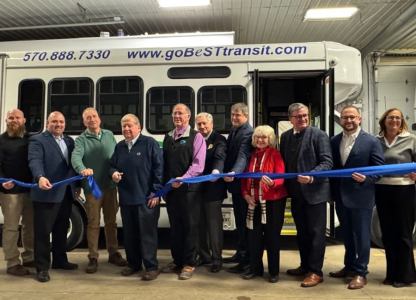
AT&T Enhances Wireless Network, Helps Keep BeST Moving Through the Endless Mountains
Modernizing network infrastructure
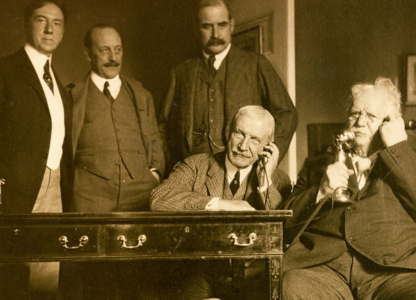
For 150 Years, Connecting Georgians Has Been Our Calling

