
Then, Now, and What’s Next: 30 Years of the Telecommunications Act
Modernizing network infrastructure
Then, Now, and What’s Next: 30 Years of the Telecommunications Act
AT&T Blog Team
February 5, 2026
Key insights
01
February 8, 2026, marks the 30th anniversary of the passage of the Telecommunications Act of 1996. Since then, providers have invested $2 trillion in U.S. communications infrastructure.
02
The progress spurred by the Telecommunications Act enabled the expansion of modern network technologies like fiber and 5G. Now, it’s time to further adapt policy to reflect today’s digital communications landscape.
03
The FCC is playing a huge part in driving network modernization forward so that the broadband marketplace can best meet the needs of consumers in the present and future.
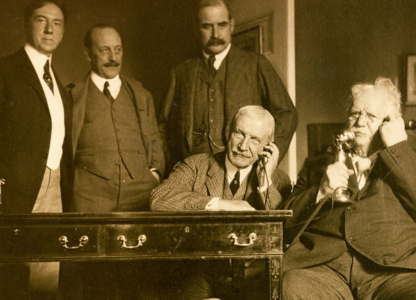
From the carrier pigeon to the text message, communications have often been defined by a series of technological breakthroughs. In March, AT&T will celebrate one of the greatest of those breakthroughs: 150 years since Alexander Graham Bell made the first telephone call. Since that call, we’ve gone from manual switchboards and shared party lines, through the days of rotary telephones that connected using copper lines, to smart phones using 5G and high-speed internet with fiber.
But today, we celebrate another milestone that shaped the modern world of digital communications: 30 years since Congress passed the Telecommunications Act of 1996.
At the time, voice calling was evolving and dial-up internet was making its entrance. Lawmakers recognized that existing rules and regulations needed to be adjusted to support this monumental shift in communications. If America was going to continue to lead on this front, they needed to act.
In a strong bipartisan effort, Congress passed the Telecommunications Act to address the rapidly changing marketplace. What followed were three decades of competition, growth, investment and innovation.
- Since 1996, providers have invested more than $2 trillion in U.S. communications infrastructure.1
The Act’s deregulatory, pro-competitive provisions set the stage for the introduction of broadband services and the massive investments in them that followed. As more competition came into play, the bar was continually raised, with multiple companies offering different types of technology – fiber, wireless, cable and satellite – some of which were in the early stages or not used to deliver voice and internet service. These technologies have dramatically changed how we do things, for the better – transforming healthcare, expanding the horizons of educational institutions, and keeping us more secure when we communicate. And, even as connectivity has improved, prices have become more affordable.
- Since 2015, broadband prices have actually fallen by 43%, while overall consumer prices have risen by roughly 36%.2
- Since 2000, the average wireless consumer bill has dropped by more than half.3
The Telecommunications Act has shown that smart public policy can and should drive technological advancements. But what was written into law in 1996 reflects a world of long-distance calling, landline telephones over now-outdated networks, and sparse competition. Now, thanks to the progress driven by the Telecommunications Act, it’s time for policy to continue to adapt again to reflect where we’re at today and advance the further expansion of network technologies like fiber and 5G.
America’s regulatory framework should make it easier for providers to upgrade outdated copper networks and focus their investments on these modern, reliable networks that meet the growing demands of consumers.
The FCC has a critical role to play as it works with providers to achieve these goals. To continue building a marketplace that delivers the rewards of technological innovation to Americans, the rules and regulations that govern our industry need to keep pace.
Over the past year, the agency has prioritized network modernization, including by removing regulatory barriers. The Commission’s recognition that modernization serves the public interest is critical as we look to further streamline the process.
Building on the innovation of the first phone call 150 years ago, AT&T has continued to modernize and push boundaries. Now, as we face the rapid growth of artificial intelligence and other new technologies, we need to adapt policies once again to support the expansion and development of next-generation networks. Just as in 1996, the actions we take today will have far-reaching impacts on America for decades to come.
1 2024 Broadband Capex Report | USTelecom (October 21, 2025)
2 2025 Broadband Pricing Index | USTelecom (November 19, 2025)
Related stories

Modernizing network infrastructure
Every Number Tells a Story: Honoring Connection as Technology Evolves

